Johari Window: To work through Prejudices and Presumptions

The Johari window tells about the open, hidden,blind, unknown aspects of self and is used by me to collaborate with clients to examine areas of communication, commitment and conflict.University of California psychologists Joseph Luft (1916–2014) and Harrington Ingham (1916–1995) helped conceptualize a model which helps see an individual’s position in and their relationships and interactions with others in a group (Spennemann, 2023).

  One exercise I encourage is to write a letter – to a loved one who has passed away- using the structure of the Johari Window and see how life changes, what things about oneself, relationships and society one can see after doing this exercise.

Case Scenario: A client in his thirties came to me with feelings of unease after having ended a decade long marriage, gone into another relationship which he broke up, and is now in a live-in relationship with another person, but has intrusive thoughts about his previous relationships.

Psychotherapy is a form of caring which is different from psychiatry (which has become a titration of medicines) and will help see the forces, factors, DNA and development in a compassionate manner. As Carl Rogers said- “ The curious paradox is that when I accept myself just as I am, then I can change." 

Application– Through Transcript and Johari Window Exercises.

Transcript of Session.


Client  ( C) : I cannot put my finger on it, but I have been feeling a bit off

Therapist (T-PB) : Is it a feeling of unease or tiredness or both

C- Unease about some memories of the previous relationships

T-PB: Is there a part of that joint energy which informs the present relationships.

C- Yes. Though they should not be coming up, I have to admit that these offsetting memories are coming up.

T-PB- Let us revisit our previous collaboration to examine the open and hidden shoulds which drive one’s thinking.

C- What purpose does that serve

T-PB- It is one of the tools one can use to deconstruct internal dialogue or interpersonal communications and create a safe space, structure and observer mind.


Psychoeducation Point: Open or Hidden Shoulds can be a road to Cognitive distortions which can be emotionally exhausting (you can download worksheet below)

Johari Window Exercises 

  The open self- what is known to both myself and others- can be truths which are undeniable over time, how they affected my relationships, especially with those I hurt, and what parts of me remained consistent and genuine. These can serve as a means to explore the personal and interpersonal dynamics, how they affect identity, isolation, meaning and freedom.

For example

C- We came together when we were in our teens. Despite her parents having warned her about me, she chose to be with me. However, around seven years after our marriage, we started drifting apart, staying together like hostel room members, avoiding any deeper discussion.

T-PB: How would she write about this phase?

This brings us to the blind self- what others can see, but I deny, or cannot see.

C- she would probably tell that I was aloof, got too busy in my work, started spending more time with my friends and was irritable when her family came to visit.

Th-PB- Did she try to mirror these aspects of your lived reality? 

C-She did try to point out, but I was not open to these suggestions. At times I was very volatile, which made her shut down. Then we both got busy with our work, created our own separate friend circles and drifted apart.

Th-PB- Knowing what you know now, can you look back and see how your body language, tone, omissions affected the relationship?

C- It led to a feeling of loneliness, misunderstanding and feeling stifled. 

T-PB: Did it lead to fear, confusion, entitlement 

This leads one to the Hidden Self- What one knows but keeps hidden

C- Yes, it led to confusion and led me astray from my commitment to this relationship. There was a sense of shame as she had supported me in my very difficult teenage years. There was a sense of rejection as we became aloof and I started seeking emotional nurturing from others.

T-PB: What truths did you hide from yourself and others?

C- I cloaked these outside relationships by deflecting questions of where I was spending my time and with whom. I also started developing a sense of entitlement by blaming my partner for these secrets.

T-PB -Is there any pattern in your family of origin which you can see repeating?

C-I never thought about it like this, but that could be an area of enquiry

We agreed to journal about this and discuss as appropriate. This helped us to see the Unknown Self (not known to others and me, what I am only discovering now)

In next sessions we discussed themes of communication, how feelings were discussed or avoided in family of origin and how these truths were handled. To assist this exercise we did the Family Dinner in Childhood Exercise (an adaptation of Family Sculpting Tool suggested by Alfred Adler- see worksheet below)

C- A day in the life of the family, a dinner together led to some old wounds reopening.

T-PB: Therapy can get uneasy and difficult before things get better. 

C-(smiling): Yes, I understand that process, but I needed to look at some buried issues which have been coming up in the way I communicate my needs and feelings.

T-PB: What cultural contexts did you revisit?

C- That was a different time, my parents had freshly moved to Canada. The stress of shifting and still having ties, pulls from the parent culture were telling on their relationship. Being stuck in survival level manual labour jobs added to their burdens.

T-PB: Can you now see the spaces which they had to navigate differently? What strengths are you building by going through this process?

..

Comments: 

  I first came to know of the Johari window during a training session with my supervisor. She taught me to see things from different hats, and at times not put on any hat (my own prejudices and presumptions) and just walk along with the client, see the world as they see it. 

This led me to sit in cafes near the community housing of Black Creek areas where living poor, working rough is common. I would visit a client weekly during my training, and help her navigate her reality, widowed in 2019 just before Covid19, institutionalized in 2022, having a teenage daughter back home in Ghana, separated from her pre-teen son in Toronto. The Johari window helped me see the relational dynamics and my own areas for growth.

Psychotherapy is a form of caring which is different from psychiatry (which has become a titration of medicines) and will help see the forces, factors, DNA and development in a compassionate manner. As Carl Rogers said- “ The curious paradox is that when I accept myself just as I am, then I can change.” 

References

Spennemann, D. H. (2023). The usefulness of the Johari Window for the Cultural Heritage Planning Process. Heritage, 6(1), 724-741.

JOHARI WINDOW WORKSHEET

Mindfulness Labyrinths

Satipatthana is a compound of Mindfulness (Sati) and either Patthana- Foundation or Upatthana – Presence. This compound can be interpreted as – Sati-patthana – Foundation of Mindfulness or Sati-upatthana- Presence of Mindfulness

Analayo-2006, 2022

Walks and Mindfulness: Niagara on the Lake-March 2025 : The 12 steps are one of the widely known spiritual paths introduced by Bill W and Dr Bob in the 1930s. They evolved from the Oxford Group. The Big Book of Alcoholics Anonymous was written around 1939. The traditions were evolved in the 1940s as the AA organization and movement grew and they imbibed the lessons from a group -The Washingtonians who had existed in 19th century

Establishing a practice of Mindfulness can start with listing the ways one is not mindful. A five minute break at the end of every three hours can be a way to check in and see where we are in the practice of a particular tool.

Labyrinths in a Retreat

Having practiced the 12 steps with a fellowship, I was eager to impress the priest about my knowledge and application of the steps, spirituality, and work with a sponsor ( a person who knows one’s story, will hold us accountable to the 12 step path, and agree to be our sponsor).

She listened to the different aspects of the program, what brought me here, how I progressed, what pitfalls and roadblocks I had observed and where I see myself in the coming months in this path. 

Practice one tool a day, and check in where you are in the awareness and application of that tool. This suggestion by the priest helped me strengthen my program and be more mindful of the way I do the program, how I spread the message and what I need to do less of.

Earlier Perspectives

Dialogues- how they arise, develop and affect.

           Silence before a conversation can be a starting point to being mindful. Be aware of the energy, the feeling (ease or unease- inside, in the other , in between) and the biological way in which the voice is generated. 

A coach once taught me the way the voice is coming from either the throat or the head or the throat or even stomach and the difference in way it comes out if one is aware from where we are speaking. It is more high pitched from higher areas and deeper if from lower areas.

He also mimicked two US Presidents and showed the difference between the folksy- I am a regular guy like you tone of one and the preacher voice of another. After he demonstrated that, I heard the speeches of both Presidents again and realized how true his observation was.

Walks in North Africa- Libya-2016 January- Establishing a Mindfulness practice can be a creative enterprise which helps us connect with energies of other times and places. In this walk in the Tripoli Medina area of North Africa, we see and connect with the energies of sea farers of the centuries gone by

Worksheet

Common Day to Day themes to be mindful of

NoThemeMPComment
15 minute break
5 minute break
33During the break I realized that my breathing, posture, gait needed to be better. I stretched by back and straightened the way I sit
23 hour slots
3 hour slotsDuring the past three hours, I was mindful of the way I drive, did I let some drivers enter the freeway before me, did I overspeed. On getting to my place of work, or study- I first checked in on the common spaces and did some service for the good of the organization, institution (or did not bother and just rushed into my own work space)
3Labyrinths
The bigger picture and detours
LabyrinthsThe bigger picture of where I am headed, what ways I can go off track. In the example above, I wrote of doing a retreat in guidance of a priest. She was my spiritual mentor. It helped me align my program a bit deeper and also made me see the primary purpose , my relationship with a higher power and the fellowship in a deeper way.
4SummaryWhat new insightAny change
SummaryThrough this exercise, I also saw the way voice is generated, how high and low pitch are related to anatomy. In addition, a coach helped me see the energy generated by two famous public speakers- one a folksy regular guy, the other a preacher voice
Write a summary of what this exercise in mindfulness meant to you
5Follow-up
Follow-upLaying the Foundation of Mindfulness I became more present to the persons I am speaking to . As a follow-up I made a note of times when I held space for them to open up, and the times when I had an urge to give them feedback and let it be.
Write one step you implemented in the past week.Discuss with a person with whom you practiceWhat new insights were gained.

M- Mastery- how good am I on a scale of 0 to 5 in implementing this tool (5 being best, 0-not existent)

P- Pleasure- how much pleasure or sense of achievement did I get in implementing this tool 

 (5 great pleasure/sense of achievement 0-non existent) (Burns & Arens, 2020)

References

Anālayo, B., Medvedev, O.N., Singh, N.N. et al. Effects of Mindful Practices on Terror of Mortality: A Randomized Controlled Trial. Mindfulness 13, 3043–3057 (2022). https://doi.org/10.1007/s12671-022-01967-8

Satipaṭṭhāna: The Direct Path to Realization

Burns, D. D., & Arens, B. (2020). Feeling Great. Findaway Voices.

Contact 

Prashant Bhatt,  develop a personalized program of Mindfulness

001-6478181385,

Psychology Today

Candlestick Counselling Services

DOWNLOAD WORKSHEET

Dragons or Donkeys

Equanimity: Managing Anger -Comparing Narrative Therapy and CBT

I make myself rich by making my wants few

         Henry David Thoreau

Modern man no longer communicates with the madman . . …

  and expels from the memory all those imperfect words, 

of no fixed syntax, spoken falteringly, in which the exchange, between madness and reason, was carried out. 

Michel Foucalt, 1961, History of Madness

Foucalt: (15 October 1926 – 25 June 1984)History of Madness (1961)

In this article we discuss ways in which different approaches can benefit in defining an issue, taking the example of anger. Anger leads to loss of equanimity.       

The word equanimity comes from Latin roots meaning “even” and “mind”. Holding what passes through your mind in spaciousness to stay in balance, moving beyond the reactive mode is achieved by Equanimity. The chain of expectations, desires, wants, are broken leading to alleviation of suffering. 

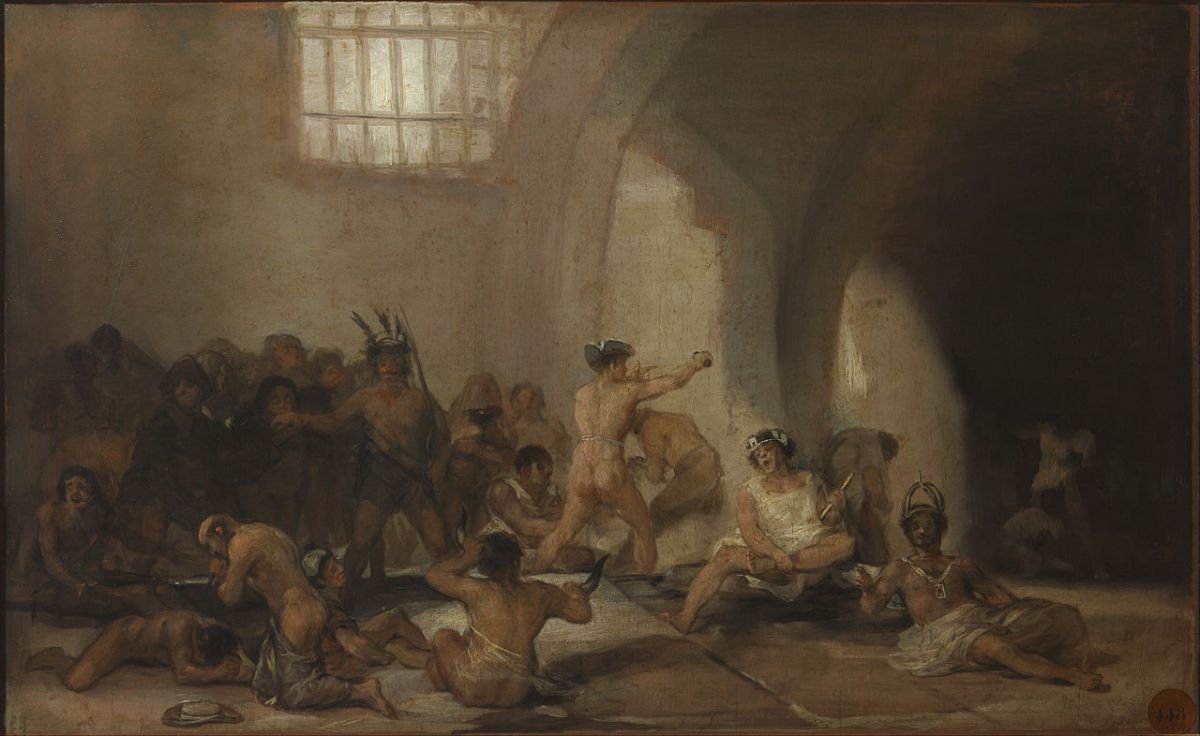
The Madhouse (Spanish: Casa de locos) or Asylum (Spanish: Manicomio) Francisco Goya- 1812-1819

The following are some exercises which I have found useful in moving into Equanimity.

1-      Write down ways in which one starts becoming less balanced. 

A written record of the ways in which one starts going into the cycle of expectations, desires, wants, fears, greed, disgust can give a good opening into the habits of the heart and head. One way to sharpen this focus is to read a newspaper/news-site for 15 minutes and keep classifying under the headings of greed, fear, disgust the feelings evoked by the articles.

 2- Developing Borders and Boundaries:  Remembering Spencer (White, 1984; White, 2007)

Spencer, the young boy who had the issue of soiling was told to characterize in near and particular terms, how this issue is affecting and ruling his life. His parents were told to characterize how this issue rules and ruins their lives. Then Spencer was asked to give a name to this issue of Soiling. He called it Mr.Mischief. They went on to relate to this issue in a particular rather than general manner, and in a near rather than distant way, thus helping define the boundaries and borders of the issue, get a better handle on it and define their relationship to the issue. 

This example of Spencer, illustrates how to externalize and objectify an issue which is affecting one’s life, and then create a statement of position map, which can help one create a plan and monitor our process.

3-     Creating personal examples : Balance of the Lotus

Eastern traditions see the Lotus flower as an embodiment of purity, enlightenment and rebirth. The balance between beauty and adversity are shown in the growth process of the Lotus, as it emerges above mud and water. It symbolizes  harmonious balance between earthly struggles and divine purity.

Nature walks and creating living symbols of these experiences has been a way to enhance balance in my life.

4- Case Scenario: Anger seen through different counselling approaches (Narrative/CBT)

Mr. S, presents with anger, which has affected his work, relationships, standing in community

NARRATIVE THERAPY APPROACH

  • Externalize – The history of anger, as if it is a creature outside of oneself waiting to get inside you
  • Therapist Role-is on listening, accepting, non-judgmental, non-confrontational statements..to be like a Junior Partner, Investigative Journalist, 

CONTRAST WITH CBT APPROACH

BASIC ID-Behaviour- writes angry letters, throws plants 

Affect                feels humiliated 

Sensations        pounding heart

Imagery              sees himself being taken away from grandson

Cognitions          I am a middle aged man who is being deprived of my rights,

                             standing in unfair manner

Interpersonal     angry at wife , sons, in-laws

Drugs                 takes alcohol to drown the pain

NARRATIVE THERAPY approach uses interventions like externalizing, metaphors, mapping to develop a near and particular relation with the issue.

Mr.S went into the history of anger, by asking to see it as a creature outside oneself who is thinking of ways to trick him into losing his calm.  Mr.S told of his early years of immigration from Bombay, India to Canada, how he saw his mother being beaten by his alcoholic father, his being bullied in school. As he became a teenager, he stopped these things as best as he knew.The “Bullied became the Bully”. On being asked to give a name for Mr.Anger he came up with two metaphors. He first called Mr.Anger the “Dragon”. However, on reflection he said, “If I am still riding this creature and getting taken for a ride in my seventh decade of life, then I am riding a Mr.Donkey”.

 After establishing rapport, agreeing that anger-related issues are worth exploring and addressing, we set about seeing how Mr.S has constructed his life around anger by

1- Externalizing anger

2- Deconstructing anger narratives

3- Re-authoring personal stories

4- Exploring values and intentions

5-Creating alternative responses

1- Externalizing anger

       Encouraging Mr.S to treat Mr.Anger as a separate entity or character helped distance himself from anger and view it as something outside of his core identity. Be doing this he gained a new perspective on his anger, started seeing how his life would be without anger and create a map to challenge the dominance of anger in his life.

2- Deconstructing anger

         We explored the stories and meanings Mr.S attaches to his anger. Through telling these stories we were able to examine the underlying beliefs, assumptions, and cultural influences that contribute to his anger. For example, as he recalled the weekend discussions which turned into angry arguments in his family of origin, he became more clear about how issues of safety, and the way to deal with un-ease through lashing out or suppressing became a dynamic in his life. This has in different forms played out in his family of creation, and he can now see this pattern even in his interactions with the in-laws of his sons. Deconstruction helped gain insight into the origins and maintenance of anger.

Scripting of the scenarios which continue to trouble him in is life in the present, helped develop alternative interpretations. Through role plays, we started developing better results.We refined these approaches through counselling and keeping an Anger Journal (He called it Riding with Mr.Donkey journal)

3- Reauthoring personal stories: 

The scripts made through externalization,deconstruction tools above helped Mr.S gain the power to rewrite his narratives, explore alternative perspectives and be more aware of how his prejudices and projections are affecting his relationships. New stories began to emerge which offered new ways of understanding and creating his experiences.

Shifting from being defined by anger to seeing himself as capable of change and growth, and being a channel of peace, understanding, and kindness has helped Mr S and his family be very different from where they were a year ago.

4- Exploring values and intentions: 

As Mr.S evolved from a “Head over Water” Survival level recovery to a more wholesome bigger version of himself, he began to examine his values and vulnerabilities, intentions and impact regarding anger. As we explored pivotal life moments, the purpose anger has served in his life, he changed his way of looking at his teenage years, and also his work, family and community. This led to a deeper understanding of his emotional experiences.

 This exploration  paved the way for aligning anger with personal values, he rebuilt his relationship with his estranged wife and children, and has started exploring healthier ways of expressing his needs, feelings, situations and story.

5- Creating alternative responses: 

The list of alternative responses to Mr.Anger (Dragon/Donkey) helped challenge the dominant narrative that aggressive or destructive behaviours result from anger. He started developing new strategies to harness anger constructively. His strengths, resources, alternative stories enabled him to respond to anger in ways more in life with desired outcomes.

Key points and summary

Creating balance through understanding the borders and boundaries of an issue helps one come up with creative ways to enhance life. Through keeping a written record of the way issues like anger speak in one’s life, how they disturb equanimity, we saw two different approaches to this issue- a classic Cognitive Behavioural therapy (CBT) approach and a Narrative therapy approach (NT). Creating a positive journal of values, symbols and metaphors (Lotus, dragon, donkey, map, territory, journey) helped co-create better life options. 

Exercise

       Do you have an issue which you need to see through a different lens? Write how it has spoken to you in your life and discuss as appropriate. Alternatively, write a letter to the issue.

White, M. (1984). Pseudo-encopresis: From avalanche to victory, from vicious to virtuous cycles. Family Systems Medicine, 2(2), 150–160. https://doi.org/10.1037/h0091651

White, M. (2007). Maps of narrative practice. WW Norton & Company.

Modern man no longer communicates with the madman . . 

. There is no common language, or rather, it no longer

 exists……..The language of psychiatry, which is a monologue 

by reason about madness, could only have

 come into existence in such a silence.

Foucalt, 1961