Around Father’s day,(2025) I went for lunch with a mentor, fellow traveler and confidante who has taught me many things over the years.
One of the things he helped me conceptualize is the “Lizard”.
“ I have a lizard in myself, which tells me that these programs of recovery, therapy, 12 steps, meditation and gratitudes are not going to work for me. The lizard takes me to dark places, which sabotage my safety, serenity and self-worth.”
Mevame Again
We sat at Mevame again (Rutherford) and discussed things which we would not discuss in a recovery meeting in front of others.
Many years ago, a senior fellow told me that though the fellowships are supposed to be anonymous, within six months, people know many things, so one should be discrete as to what one shares.
Father’s Day walk
We went through the intergenerational issues, as he recalled his earlier years in Toronto, having been put in grade 3 instead of grade 5 where he should have been. The next year, he got a double promotion, as he did well academically.
He showed me a panorama of what life was in Toronto- Don Mills area in the 1950s/60s when he went to school. We got to current issues of his wife’s trip to Australia, how the lives of his daughters, the way their marriages have evolved has affected him and his sense of family.
Life in America-(From Number our Days- Barbara Myerhoff)
We discussed Number of Days, written by the cultural anthropologist Barbara Myerhoff, who studied a community of elderly Jews in the mid 1970s. This pioneering ethnographic work is an intimate chronicle of the lives of elderly Jewish Immigrants in Venice, California, particularly those associated with the Israel Levin Senior Center. Her work weaves storytelling, anthropology, and reflexivity to illuminate how identity, memory, and community persist and adapt in the face of aging, loss, and marginalization.
Application
In my work with marginalized and minoritized communities, I have worked with elderly persons from the Jewish community, South Asian and Asian elderly persons and also their caregivers. Caregiver burnout is an often neglected aspect which hurts the family dynamic.
Every Object has a story- the work of Sara Angelucci-
Creative solutions: Needle and Thread
God’s greatest invention
A little needle
Humble, bright and quick,
A gift to Eve
To make us clothes,
She sews and takes us
From animals to people.
In Paradise what are we?
Pure nature, without inventions.
Not yet born,
Until a needle
Makes us into me.
“These are a tailor’s words. The poem, you see, I wrote in Jewish. That is because Jewish is the right language for the sweatshop. Not Hebrew- too elevated. Not French- too refined. Not Polist-too robust. Only Jewish could express a tailor’s thoughts in America, working with his needle. (Page 69,70; Number our Days, Barbara Myerhoff)
Remembering Father’s Day Walk-Malta 2012
This conversation in Rutherford – Maple, Greater Toronto Area reminded me of a walk with a senior of the Maltese Indian community in 2012. He graciously invited us for lunch, recalled his family and community journeys from India, East Africa to Southern Europe and how things have evolved over the decades. Every journey has its surprises. After a session of Yoga at the Community centre at San Gjwann, we went for lunch at Valletta and then he took us for a walk through a cemetery where some of the community elders have been laid to rest.
Readings and Reflections-Connection with Culture and Community:
Kariya Park-Mississauga-June 2025
A Teacher’s Prayer
The boy who was once demoted to grade 3, eventually became a teacher, and influenced many lives. Apart from teaching many about the steps of recovery, he also gave me the gift of a Teacher’s Prayer.
“As a teacher, I can influence the lives of students. So I have to take extra care. One remark can do a lot of damage to a teenager already struggling with self-esteem and confidence issues,” he told me as we ended our lunch meeting.
Equanimity: Managing Anger -Comparing Narrative Therapy and CBT
I make myself rich by making my wants few
Henry David Thoreau
Modern man no longer communicates with the madman . . …
and expels from the memory all those imperfect words,
of no fixed syntax, spoken falteringly, in which the exchange, between madness and reason, was carried out.
Michel Foucalt, 1961, History of Madness
Foucalt: (15 October 1926 – 25 June 1984)History of Madness (1961)
In this article we discuss ways in which different approaches can benefit in defining an issue, taking the example of anger. Anger leads to loss of equanimity.
The word equanimity comes from Latin roots meaning “even” and “mind”. Holding what passes through your mind in spaciousness to stay in balance, moving beyond the reactive mode is achieved by Equanimity. The chain of expectations, desires, wants, are broken leading to alleviation of suffering.
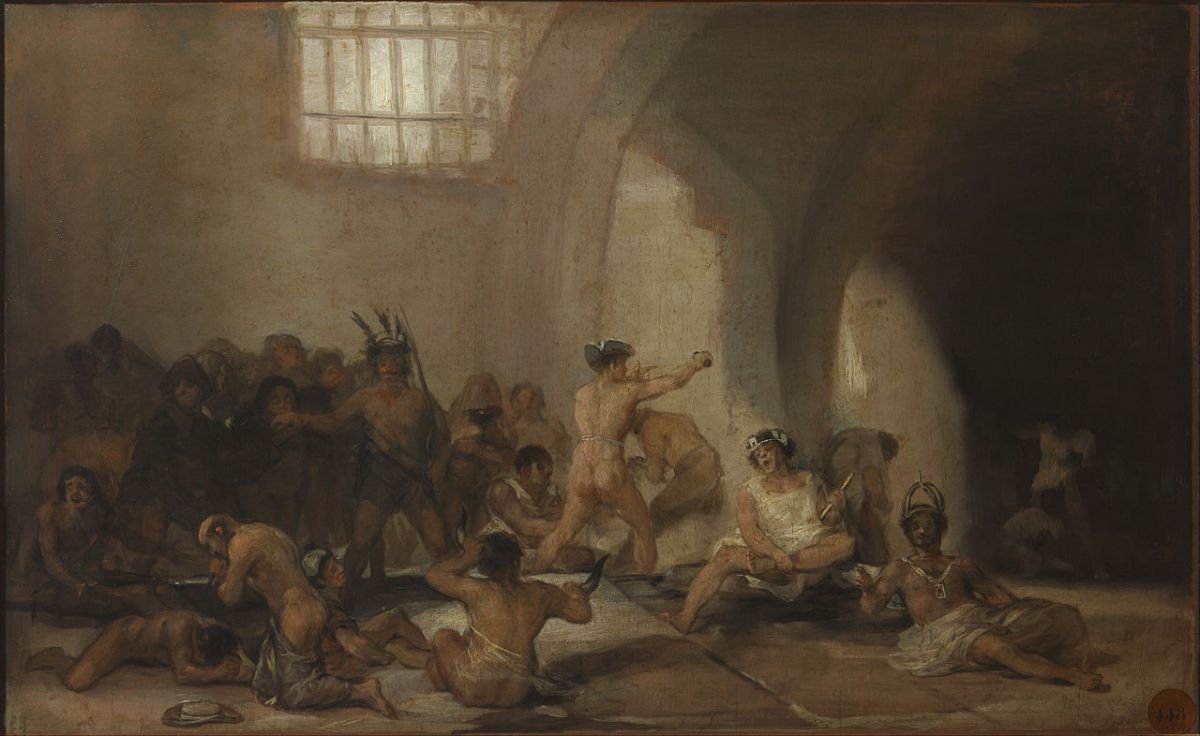
The Madhouse (Spanish: Casa de locos) or Asylum (Spanish: Manicomio) Francisco Goya- 1812-1819
The following are some exercises which I have found useful in moving into Equanimity.
1- Write down ways in which one starts becoming less balanced.
A written record of the ways in which one starts going into the cycle of expectations, desires, wants, fears, greed, disgust can give a good opening into the habits of the heart and head. One way to sharpen this focus is to read a newspaper/news-site for 15 minutes and keep classifying under the headings of greed, fear, disgust the feelings evoked by the articles.
Spencer, the young boy who had the issue of soiling was told to characterize in near and particular terms, how this issue is affecting and ruling his life. His parents were told to characterize how this issue rules and ruins their lives. Then Spencer was asked to give a name to this issue of Soiling. He called it Mr.Mischief. They went on to relate to this issue in a particular rather than general manner, and in a near rather than distant way, thus helping define the boundaries and borders of the issue, get a better handle on it and define their relationship to the issue.
This example of Spencer, illustrates how to externalize and objectify an issue which is affecting one’s life, and then create a statement of position map, which can help one create a plan and monitor our process.
3- Creating personal examples : Balance of the Lotus
Eastern traditions see the Lotus flower as an embodiment of purity, enlightenment and rebirth. The balance between beauty and adversity are shown in the growth process of the Lotus, as it emerges above mud and water. It symbolizes harmonious balance between earthly struggles and divine purity.
Nature walks and creating living symbols of these experiences has been a way to enhance balance in my life.
4- Case Scenario: Anger seen through different counselling approaches (Narrative/CBT)
Mr. S, presents with anger, which has affected his work, relationships, standing in community
NARRATIVE THERAPY APPROACH
Externalize – The history of anger, as if it is a creature outside of oneself waiting to get inside you
Therapist Role-is on listening, accepting, non-judgmental, non-confrontational statements..to be like a Junior Partner, Investigative Journalist,
Imagery sees himself being taken away from grandson
Cognitions I am a middle aged man who is being deprived of my rights,
standing in unfair manner
Interpersonal angry at wife , sons, in-laws
Drugs takes alcohol to drown the pain
NARRATIVE THERAPY approach uses interventions like externalizing, metaphors, mapping to develop a near and particular relation with the issue.
Mr.S went into the history of anger, by asking to see it as a creature outside oneself who is thinking of ways to trick him into losing his calm. Mr.S told of his early years of immigration from Bombay, India to Canada, how he saw his mother being beaten by his alcoholic father, his being bullied in school. As he became a teenager, he stopped these things as best as he knew.The “Bullied became the Bully”. On being asked to give a name for Mr.Anger he came up with two metaphors. He first called Mr.Anger the “Dragon”. However, on reflection he said, “If I am still riding this creature and getting taken for a ride in my seventh decade of life, then I am riding a Mr.Donkey”.
After establishing rapport, agreeing that anger-related issues are worth exploring and addressing, we set about seeing how Mr.S has constructed his life around anger by
1- Externalizing anger
2- Deconstructing anger narratives
3- Re-authoring personal stories
4- Exploring values and intentions
5-Creating alternative responses
1- Externalizing anger
Encouraging Mr.S to treat Mr.Anger as a separate entity or character helped distance himself from anger and view it as something outside of his core identity. Be doing this he gained a new perspective on his anger, started seeing how his life would be without anger and create a map to challenge the dominance of anger in his life.
2- Deconstructing anger
We explored the stories and meanings Mr.S attaches to his anger. Through telling these stories we were able to examine the underlying beliefs, assumptions, and cultural influences that contribute to his anger. For example, as he recalled the weekend discussions which turned into angry arguments in his family of origin, he became more clear about how issues of safety, and the way to deal with un-ease through lashing out or suppressing became a dynamic in his life. This has in different forms played out in his family of creation, and he can now see this pattern even in his interactions with the in-laws of his sons. Deconstruction helped gain insight into the origins and maintenance of anger.
Scripting of the scenarios which continue to trouble him in is life in the present, helped develop alternative interpretations. Through role plays, we started developing better results.We refined these approaches through counselling and keeping an Anger Journal (He called it Riding with Mr.Donkey journal)
3- Reauthoring personal stories:
The scripts made through externalization,deconstruction tools above helped Mr.S gain the power to rewrite his narratives, explore alternative perspectives and be more aware of how his prejudices and projections are affecting his relationships. New stories began to emerge which offered new ways of understanding and creating his experiences.
Shifting from being defined by anger to seeing himself as capable of change and growth, and being a channel of peace, understanding, and kindness has helped Mr S and his family be very different from where they were a year ago.
4- Exploring values and intentions:
As Mr.S evolved from a “Head over Water” Survival level recovery to a more wholesome bigger version of himself, he began to examine his values and vulnerabilities, intentions and impact regarding anger. As we explored pivotal life moments, the purpose anger has served in his life, he changed his way of looking at his teenage years, and also his work, family and community. This led to a deeper understanding of his emotional experiences.
This exploration paved the way for aligning anger with personal values, he rebuilt his relationship with his estranged wife and children, and has started exploring healthier ways of expressing his needs, feelings, situations and story.
5- Creating alternative responses:
The list of alternative responses to Mr.Anger (Dragon/Donkey) helped challenge the dominant narrative that aggressive or destructive behaviours result from anger. He started developing new strategies to harness anger constructively. His strengths, resources, alternative stories enabled him to respond to anger in ways more in life with desired outcomes.
Key points and summary
Creating balance through understanding the borders and boundaries of an issue helps one come up with creative ways to enhance life. Through keeping a written record of the way issues like anger speak in one’s life, how they disturb equanimity, we saw two different approaches to this issue- a classic Cognitive Behavioural therapy (CBT) approach and a Narrative therapy approach (NT). Creating a positive journal of values, symbols and metaphors (Lotus, dragon, donkey, map, territory, journey) helped co-create better life options.
Exercise
Do you have an issue which you need to see through a different lens? Write how it has spoken to you in your life and discuss as appropriate. Alternatively, write a letter to the issue.
White, M. (1984). Pseudo-encopresis: From avalanche to victory, from vicious to virtuous cycles. Family Systems Medicine, 2(2), 150–160.https://doi.org/10.1037/h0091651
White, M. (2007). Maps of narrative practice. WW Norton & Company.
Modern man no longer communicates with the madman . .
. There is no common language, or rather, it no longer
exists……..The language of psychiatry, which is a monologue




 Candlestick Counselling and Psychotherapy Services