Subterranean Life of the Hour

Island Lake Conservation Area-Orangeville-Ontario; Sep 14-2025: Exploring the Subterranean Life of the Hour is one of my tools of growth.

In existential therapy, the “life of the hour” and what is unfolding in this very moment is used as a tool to help healing.

I have worked with supervisors who taught me to harness these moments and transform and expand the energy of the safe healing moments to other aspects of life. Another tool is to go beneath the surface of a client’s words, silences, what is left unsaid or the nervous tone, subtle giggles 

SLH-Subterranean life of the hour -James F.T.Bugental (1915-2008)

James Bugental, was the President of the Association for Humanistic Psychology (1967). He coined the term “subterranean life of the hour” to describe the implicit, unspoken undercurrents in session. This helps develop deeper understanding of feelings, meanings, existential concerns. The different dimensions of SLH include (but is not limited to)

1- Presence and Absence Shifts

How much each is fully engaged or avoiding or going on tangents 

2- Non verbal cues

The tone, volume, silence, interruptions, bodily tension, hesitations and energy of the room

3-Existential themes 

Themes such as freedom, mortality, isolation, meaning that may not be consciously acknowledged but shape the therapeutic moment.

4- The Living Process Underneath

Listening not only to what is said but also to the living process underneath, the background, development and energy of the therapeutic relationship. How one shows up for the sessions and willingness or unwillingness (it is an evolving spectrum) to engage and be accountable.

Case Scenario

Consider a man in his 40s who has just ended a 15-year marriage. He now lives with a new partner, but both have decided not to not get married and just see how things develop.  He feels unsettled about how he has to repeat same things again and again but his partner does not seem to get it. There is uneasiness about the hours spent in work -juggling between clients and extended family in different time zones and then spending weekends in costly dinners and outings.

 When the therapist gently suggests exploring how his or his partner’s family of origin and family of creation issues (both have had previous marriages) may be shaping his struggles, he lashes out angrily:

Client (C ) : I don’t want to talk about my family or the past. That’s not why I came here!”

Therapist (T):  (feels the sting of his anger but resists retreating into intellectual explanations)
I can feel your pushback. Something in our relationship tells me that we want to explore this moment, not go anywhere else

Principle: Instead of intellectual explanations, use reflection, touch on the “life of the hour” and the “Subterranean life of the hour” to harness the fears which fuel the anger. Leverage the fear of losing control, or being engulfed in tangential past issues which have gone by and not be seen in the present or be mis-seen.

Present Field: Dwelling together in the present field: his anger, the therapist’s steadiness, the tension, the unspoken vulnerability can be used to harness the therapeutic relationship as a supportive relationship.

Worksheet

The following worksheet explores the tool of Subterranean Life of the Hour, with examples from the above scenario, and prompts of grounding, naming, attunement, dialogue and integration. If you would like to explore an existential issue – in a customized manner, you can reach out to Prashant Bhatt  or 6478181385


Worksheet: Exploring the Subterranean Life of the Hour

This worksheet is meant to help clients (and therapists) pause, reflect, and tune into the implicit life of the present moment.

Eg-Client – in his 40s-struggling with his common law partner lashes out angrily saying has not come here to see family of origin or family of creation (past failed marriage) issues

1- Presence and Absence Shifts

How much each is fully engaged or avoiding or going on tangents 

Principle: Engagement

Rest Stop

 Does the lashing out mark a rupture. If yes, how would you see it going forward.

If no- why not?

2- Non verbal cues

The tone, volume, silence, interruptions, bodily tension, hesitations and energy of the room

Principle: Mindfulness

Tool: Grounding

Take three slow breaths.

Notice your body: Where do you feel heaviness, tightness, warmth, or flow?

Let the present moment be enough.

Let Go and integrate the breaths with any uneasy feelings

3-Existential themes 

Themes such as freedom, mortality, isolation, meaning that may not be consciously acknowledged but shape the therapeutic moment.

Principle:  Naming the Hour

Tool: Without analyzing, put words to what is happening here and now.

Eg- The therapist named the anger, unease to explore habits of heart and head.

4- The Living Process Underneath

Listening not only to what is said but also to the living process underneath, the background, development and energy of the therapeutic relationship. How one shows up for the sessions and willingness or unwillingness (it is an evolving spectrum) to engage and be accountable.

Principle: Attunement Practice

  • Notice the other person’s face, tone, body language.
  • Notice your reactions (tightening, softening, pulling away, leaning in).
  • Practice holding both realities—mine and theirs—without judgment

Eg- The creation of empathy, going into the causes and conditions which led a person to have a certain position may be useful clues

Exploring Disconnection, resonance, what is left unspoken can be part of growth.

Rest Stop: When was the last time you felt unheard? How did you react? How do you feel about it now?

Note after the first three steps of 

1- Grounding

2- Naming

3- Attunement 

We can deepen this process by

4- Dialogue

5- Integration

Step 4. Dialogue with the Subterranean Life

Imagine the subterranean voice of the moment speaking.

1- Mindfulness of time tool- If we were having this conversation 20 years from now, what part of yourself would be protective, supportive of your needs.

2- Mindfulness of time-with spirit tool: if we were two spirits (on a human journey) having this conversation 200 years from now, what would you smile at.


Step 5. Integration

I use Mindfulness (Satipatthana) and Johari window to work through the issues of head and heart, intuition and intellect and create a customized map to help clients navigate and negotiate their journeys.

For eg- in the man in his forties who lashed out, we returned to the breath, body, energy of the room and wrote down one sentence which would capture what he discover about himself, his values and how the world works from the existential dissection of his moments of anger.

End Note

Intellectualization would lead to dismissal using words like “resistance” or pathologizing using terms as “avoidance”. Instead, by leaning into the subterranean life of the hour, engaging, grounding, naming and attuning with the pushback, we explored this factor with an attitude of invitation.

This attuned stance created a doorway to deeper truths: his anger was not against the therapist but against the unease of losing safety again.

All recovery lies in the pause. Pausing to notice and harness the subterranean life of the hour helps discover the underlying truths and longings for connection, recognition and freedom.

From The First Day We Spoke

Typically a man expresses self-confidence and assurance in an early conversation with a prospective online match. Most women I know are attracted to this quality, and I had fallen for that brand of Alpha male myself plenty of times over the years. So when Jim told me that first night, “ I have a lot of self-doubt, : and said, “ I worry that I’m not a good enough man,” I might have turned and run; in fact I felt an impulse to do so. I suppose others would have too, though I am not sure that Jim had shared that level of self-disclosure with many. He could play the game of a successful San Francisco attorney, and he looked the part. He just never played it with me. 

From the first day we spoke, he told me the truth about himself. I did the same

The Best of Us, Joyce Maynard, page 17.18 

Learning from literature tool , creating existential maps and choosing to connect despite doubts are three pillars on which I help couples build their Couple-Bubble.

Learning from Literature: Jim (James Barringer-June 12-1952-June 16-2016)…

from the Best of Us- by Joyce Maynard

Jim and Joyce (Source-https://www.joycemaynard.com/the-best-of-us-21)

In the paragraph above, Jim is a mature man who instead of projecting an Alpha male personality, playing games, comes out as a person who is able to face the truth of his many facets with honesty and openness. This shapes the kind of man, and partner, he has become.

For those wanting to do a deeper dive into Learning from Jim– I would highly recommend this book, in which Jim talks openly about his failed first marriage, his long-term partnership with a colleague and how that relationship broke down as his children never accepted his partner, the changes in his life as he became associated with Joyce.

Their struggles with cancer, the medical system and the existential map are described in nuanced detail by the author.

Earlier Perspectives: Nuances and Lessons from the Dying-about Life and Living

It reminded me of another book on struggles with cancer, written by Paul Kalanithi – when breath becomes air- which I had discussed in a book club in 2019.

When Breath Becomes air-by Paul Kalanithi (discussed in Feb 2019 book club)

Creating the Couple Bubble-Choosing Connection over Doubt

In our work with those struggling with communication in intimate relations, we use Erikson’s stages of psychosocial development to develop a framework of choosing connection versus distancing. 

Connection will lead to creation of a Couple Bubble in which both partners affirm each other, rather than a distancing pattern of blaming, hiding behind Victimhood and Self Righteousness.

Erikson’s Stages of Psychosocial Development are

  • Trust vs. Mistrust. Age developed: Birth to 18 months. …
  • Autonomy vs. Shame and Doubt. …
  • Initiative vs. Guilt. …
  • Industry vs. Inferiority. …
  • Identity vs. Confusion. …
  • Intimacy vs. Isolation. …
  • Generativity vs. Stagnation. …
  • Integrity vs. Despair.

Jadoo-Jail-Jao Yahan se…

(Black Magic-Incarceration-Return

variations in South Asian Immigrant Community)

Intimacy or lack of it, is linked to demon dialogues like- His family has done Kala Jadoo- Black Magic and is adversely affecting our relationship.

I tell such persons, who are sticking to their guns that while I do not know much about Black Magic, I can see some forms of Black and White Thinking in these dialogues.

Black and White thinking- is a form of Cognitive Distortion which is judgmental, stems from overthinking, all or none, emotional reasoning, discounting the positive and lack of openness to see the habits of the head and heart which keep us in negativity, isolation and blame-victim mode.

Choosing Intimacy, Not Isolation

Themes: Core of Intimacy vs. Isolation.

If one is practicing a program of recovery, one will see doubts as hindrances and in a calm, confident, clear manner see where black and white judgmental tones are hindering the couple-bubble.

In session this may look like this:

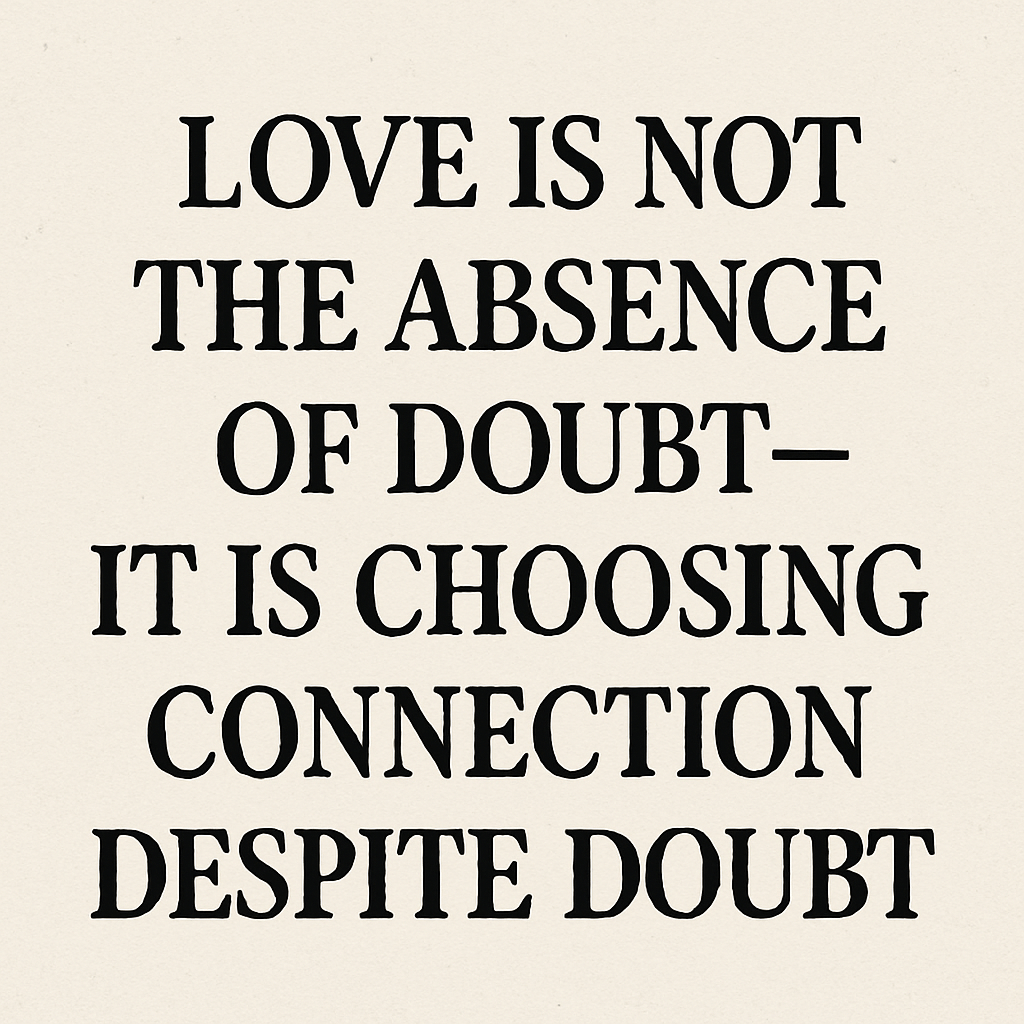
Therapist frame: “Love is not the absence of doubt—it is choosing connection despite doubt.”

Exercise: Couples practice Existential Dialogue:

Partner A says: “One fear I carry is that this talk of Black Magic is eroding my sense of safety

Partner B responds only with: 

Here one can go two ways- the Blame Mode or the Responsibility mode

Blame Mode- You are under the spell of your mother, family of origin and ignore me and this black magic is affecting my health, sleep and sense of future

Responsibility mode: I hear you, understand how this may make you feel uneasy. May you be safe and happy. 

Agreeing to take a time out, mindful pause when things are escalating into negativity, can be a form of Self Care and Relationship care.

Existential Framework:

Intimacy versus Isolation is the psychosocial stage which in this period of uncertainty can challenge the Couple-Bubble- where instead of looking out to see the obstacles of intimacy, trust, each partner becomes caught in Black and White, Us versus Them thinking which is a gateway to Mistrust, lack of faith in the relationship and the trend to going their separate ways. Research documents and contextualizes longevity of relationships in 21st century. 

Altruism and Shared values are key ingredients for maintaining relationships in a challenging society.

Discussion: Explore how parenting vision, family vision and miscarriages and uncertainty make one retreat into isolation (avoiding intimacy, emotional distance).

Existential Reframe: Intimacy is about standing side by side in uncertainty.

Homework Suggestions: 

Routines of Service Eg-Asking and listening how each other’s day went

Rhythms of Togetherness Evening tea, nature walk together, a shared meal

Reading and discussing a book together 

(would highly recommend -The Best of Us) 

Rituals of Intimacy Eye contact 5 minutes, Prayer-Chanting together

Drawing/painting a joint picture

https://maps.app.goo.gl/CYiqv2yiyzDzvq3t9

COUPLE BUBBLE

Exploring existential frameworks, life stages, the needs and feelings of each other and the consequences of having a long term committed relationship on one’s sense of self, future and relational safety are some ways to build a couple bubble.

In the next blog article we will discuss how to Establish and Secure a Couple Bubble.

As an additional tool to see one’s blind spots, the article on Johari Window and Patterns in Relationships can be helpful.

References

Heim, C., & Heim, C. (2023). “How did you stay together so long?” Relationship longevity, a cross‐generational qualitative study. Journal of Marital and Family Therapy, 49(4), 781-801.

Work sheet- Growing Together

Look For Her Among Her Friends

Look for her among her friends- a suggestion by Irvin Yalom, in his book “Staring at the Sun” set me down memory lane. I encourage this to clients suffering from grief. The book tells how self-disclosure can be used to further the therapeutic collaboration.

Recognize, Accept Investigate Non judgment and Mr.Anger

As the anniversary of his mother came, he called his mother in law now in her 80s. She was one of his mother’s good friends.

My friend told of the times when he was being told in subtle and not so subtle ways to not bother others. 

Grief is a journey, and my friend Mr.A has helped me see many ways in which he has mapped his journey of grief. 

One of the things he grieves is the loss of his home, which he built, in the 1990s, when his mother was alive. Now he goes to the same house, to do service, having spent many years in 12 step recovery. However, he did confide that there are uneasy moments when he is told to shape up or shape out, which does not go well for his self esteem and connection.

In the blog on Anger (Dragons or Donkeys) – we had gone through the different approaches to Anger using the classical CBT model- STOPP tools and the Narrative therapy tools of externalization, scaffolding conversations and remembering.

One year on, we did a review of the issues faced through the Grief lens – remembering his mother, who passed away from cancer.

Recognizing his mother’s educator voice within him has been an important part of his growth journey. He remembers the sacrifices, adjustments and nurturing which went in the early years of coming to Canada. She was a well established teacher in a leading school of Bombay (Now known as Mumbai). The best job she could get was that of a bank teller. Her husband, who was a leading marketing executive, became a security guard.

Accepting the hurts and how they are affecting his day, and using the mindfulness tool of going back to a time in his childhood when he had seen abuse in his family of origin became a powerful tool to become more aware of his patterns.

We made a movie – and went back to one of the parties of his childhood, when after the party there would be bitter arguments between his parents. “When I was small, I used to hide and was terrified by the arguing which sometimes became physically abusive,” he said, reliving those moments. We went into the four areas of mindfulness- the body, feelings, thoughts and principles. At his level as a ten year old, he could remember the freezing of the body, the confusion and fear, bitterness at how the evening gathering which was so pleasant had deteriorated to this mess and the principle of family foundation being violated while being there for the four children. 

In the here and now, of the therapy session, we went through these in a safe space and he could see those patterns being repeated in the recent episode of being told to Shut Up or Get Out. 

As we linked the family of origin issue, how that memory stays in his body, feelings, thoughts and what new knowledge he has gained through therapy, he smiled at the habits of his head and heart.

Humber Walks-July 2025: Etienne Brule Park, Old Mills area of Toronto has been one of my thinking places for many years. Here I meet trusted fellows and friends. One such friend told me about the grief of the passing away of his mother, when he was 19 years old, and how he then descended into a life of Drugging and Alcohol. Through a program of Recovery he has been sober for over three decades and helps carry the message of Recovery-One Day at a Time.

Post script: Later that week, he made a phone call to his mother in law, now in her 80s, who told him, when his marriage was getting over. “For me, you will always remain my son-in-law, no matter what happens between my daughter and you.” That moment of being valued served as a message of connection, hope and reconciliation in some of the darkest moments of his life.

Look for her among her friends, the principle came alive in a near and particular way for my friend.

References: Adapted from

Adler, A. (2014). Individual psychology. In An introduction to theories of personality (pp. 83-105). Psychology Press.

Siegel, D. J. (2010). The Mindful Therapist: A Clinician’s Guide to Mindsight and Neural Integration (Norton Series on Interpersonal Neurobiology). WW Norton & Company.

Yalom, I. D. (2008). Staring at the sun: Overcoming the terror of death. The Humanistic Psychologist, 36(3-4), 283-297.

Breeze – Mindfulness of Breath – Some conversations on International Self Compassion Day-2025

International Self Compassion Day -2025-(July 19-2025)

In Kristen Neff’s book on Self Compassion she lists Common Humanity, Self Kindness and Mindfulness as three components of Self Compassion and also gives interesting exercises on being average which brings to focus the competitive nature of our culture, how the pressure to be better erodes the fun in just being. 

So, as part of this exercise of being average, I went for a walk by the Humber-Etiune Brule -Old Mills, had a cheese tuna sandwich at Caldense Symington and a small coffee at the Tim Hortons on Bloor with three trusted fellows-spiritual fellow travelers. 

We are just average persons in Greater Toronto Area-GTA, getting along in our lives. Each relationship has taught me some nuances of day to day life, enriched me and helped develop a deeper understanding of our shared journeys.  

In this blog will tell of some lists, some talks across the world and my experiences in interrogating the Satipathana and Anapanasati Suttas which have helped further my mindfulness practices.

Common Humanity: Our shared walks in North Africa

As part of intentionally reaching out, had a talk with a fellow traveler, a South Asian who has lived and worked in the Arab world. We had spent almost a decade together in Tripoli, walked together during the 40 year celebrations of Gaddafi’s regime and then witnessed first hand on the ground the revolt in the 42nd year. I remember the day he and another fellow traveler sat together for a dinner which I had imagined would happen soon, after the intense fighting would stop. Our journeys together helped me see the way he has imbibed humour to lessen the pain of forced internal migration from his homeland Kashmir. Navigating the medical world in different continents have helped him see what is possible, where we have dilemmas and how to negotiate with persons in power.

Self Esteem: Readings by the Humber, Lake Ontario, Rouge and the Zoo

Sketch Studies, Mindfulness walks in Nature and Discussions in Cafes

Does one matter? Am I a 5/10 or more when it comes to having a positive effect or less? (10 being yes I matter). These questions by Neff made me recall some walks I had in the zoos of Tripoli in 2009 when I told my sons about Thoreau’s Walden pond and the principles of Objectivity, Simplicity, Self Reliance which guided  Transcendentalists like Emerson, Thoreau, Alcott (author of Little Women).

Doing readings together, keeping notes, and engaging in a reading group, imbibing the lessons into a reading journal are part of my family legacy, passed on to me by my parents, grandparents and uncles, aunts, sisters. Following this, it gave me immense satisfaction to read about my son’s recent visit to Walden pond where Thoreau stayed in the mid 19th century.

This morning, on International Self Compassion day- went through some works of Kiran Desai-Inheritance of Loss, and reflected upon the relationship between the Judge (Jemmubhai), and the cook, who asks for punishment for his wrong doings, how his orphaned granddaughter Sai tries to intervene. Set in the backdrop of the Gorkhaland movement, the novel follows the stories of Biju, the cook’s son as a worker in the restaurants of New York City and his interactions with other Indian diaspora from different continents. The Indians of East Africa have a different way of relating to India, USA. 

Going by the reading journals and discussion groups I have had over the decades I would give myself a rating of over 5/10 in whether I mattered to my groups, family in this aspect.

Mindfulness: The Breath as a Gateway to Satipaṭṭhāna and Ānāpānasati

We Are of a Tribe by Alberto Rios

The dream of sky is indifferent to all this,
Impervious to borders, fences, reservations.

The sky is our common home, the place we all live.
There we are in the world together.

The dream of sky requires no passport.
Blue will not be fenced. Blue will not be a crime.

Look up. Stay awhile. Let your breathing slow.
Know that you always have a home here

Was guided by an experienced practitioner on how the breath is the gateway to both Satipaṭṭhāna and Ānāpānasati the intention is different. In Satipaṭṭhāna there is mindfulness with letting go , non attachment and the structure which gives  grounding at each level. The sutta has seven spokes at levels of body (anatomy, elements, death), feelings, thoughts and principles. Ānāpānasati moves from long and short breath awareness to whole body awareness and calming.

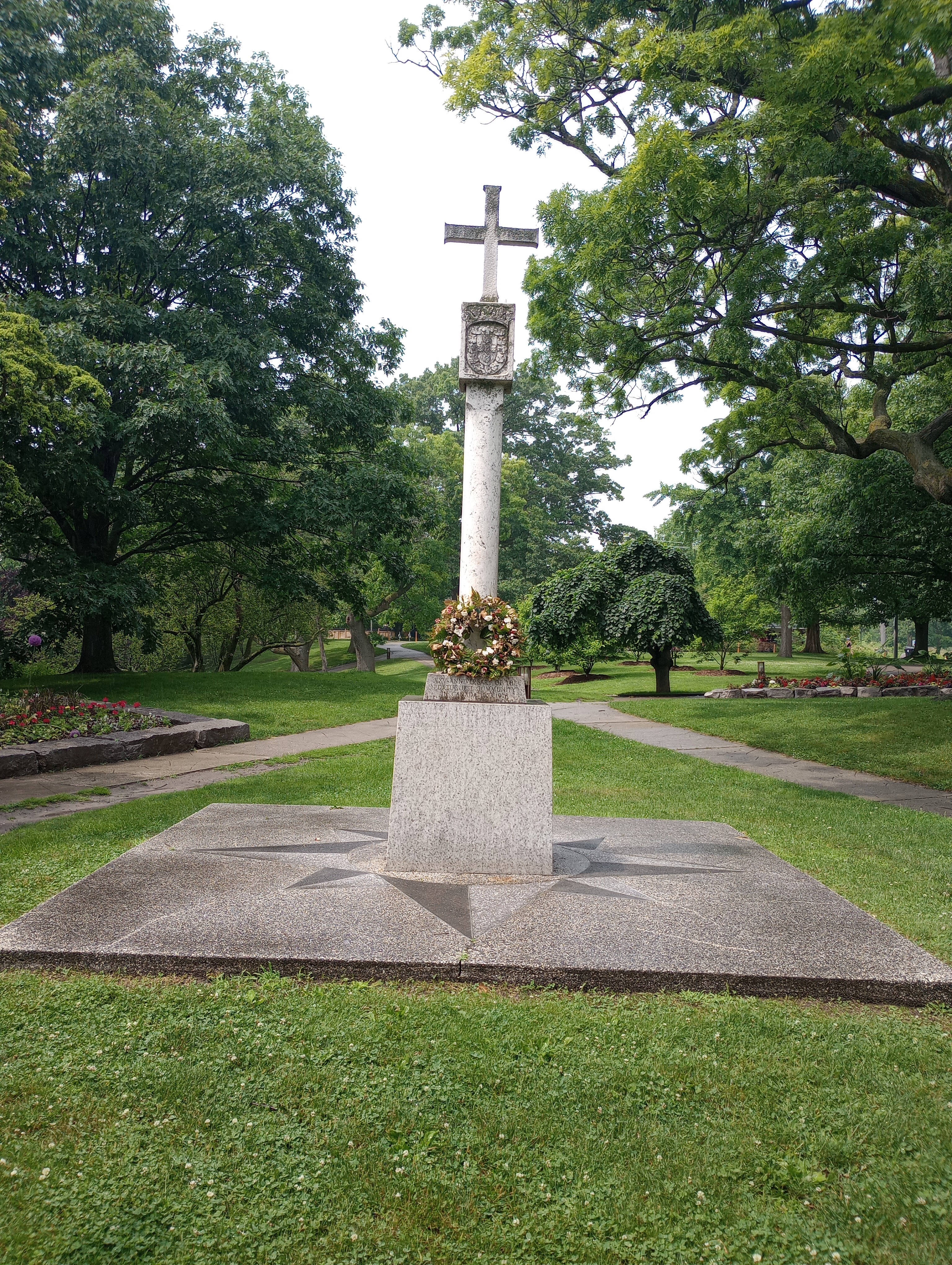
Exploring Local Histories-The Portuguese community in GTA-commemorated at High Park

Other practices I use to ground are 

(a) Metta- thank each part – from the other, thank the short breath, send loving kindness to any painful sore part of body

 (b) Mentors- invoking the spirit of Individual mentors . Invoking the spirit of the Sangha

( c) Mending my ways- the amends steps of 12 step spirituality.

Reference

Neff, K. (2019). The yin and yang of self-compassion: Cultivating kindness and strength in the face of difficulty. Sounds True.

Download Worksheet on Self Compassion

EARLIER PERSPECTIVES

EXPLORING COMMON HUMANITY- THROUGH READING JOURNALS

2025-JUNE- INHERITANCE OF LOSS

2014-FEB : REMEMBERING CHARLIE ANDREWS 

12th February is the feast of Charlie Andrews, the Christian missionary and close friend of Mahatma Gandhi. Viewed by some scholars as the alter-ego of the Mahatma, C F Andrews went on to do things in Fiji and Caribbean which Gandhi himself could not do physically. In Richard Attenborough’s “Gandhi” there is a scene in which when CF Andrews comes to bid goodbye, Gandhi says-..(paraphrased) –Between us there are no goodbyes. You will always be with me in my heart.

2009-FEB- REMEMBERING ANSAL ADAMS

“I believe in beauty. I believe in stones and water, air and soil, people and their future and their fate.” This was the personal philosophy of the great American photographer Ansel Adams whose birthday falls on February 20. He developed the zone system, a way to determine proper exposure and adjust the contrast of the final print. 

Understanding the Lizard Within: Insights from Father’s Day

Around Father’s day,(2025) I went for lunch with a mentor, fellow traveler and confidante who has taught me many things over the years.

One of the things he helped me conceptualize is the “Lizard”.

 “ I have a lizard in myself, which tells me that these programs of recovery, therapy, 12 steps, meditation and gratitudes are not going to work for me. The lizard takes me to dark places, which sabotage my safety, serenity and self-worth.”

Mevame Again

We sat at Mevame again (Rutherford) and discussed things which we would not discuss in a recovery meeting in front of others.

Many years ago, a senior fellow told me that though the fellowships are supposed to be anonymous, within six months, people know many things, so one should be discrete as to what one shares.

Father’s Day walk

We went through the intergenerational issues, as he recalled his earlier years in Toronto, having been put in grade 3 instead of grade 5 where he should have been. The next year, he got a double promotion, as he did well academically.

He showed me a panorama of what life was in Toronto- Don Mills area in the 1950s/60s when he went to school. We got to current issues of his wife’s trip to Australia, how the lives of his daughters, the way their marriages have evolved has affected him and his sense of family.

Life in America-(From Number our Days- Barbara Myerhoff)

We discussed Number of Days, written by the cultural anthropologist Barbara Myerhoff, who studied a community of elderly Jews in the mid 1970s. This pioneering ethnographic work is an intimate chronicle of the lives of elderly Jewish Immigrants in Venice, California, particularly those associated with the Israel Levin Senior Center. Her work weaves storytelling, anthropology, and reflexivity to illuminate how identity, memory, and community persist and adapt in the face of aging, loss, and marginalization.

Application

In my work with marginalized and minoritized communities, I have worked with elderly persons from the Jewish community, South Asian and Asian elderly persons and also their caregivers. Caregiver burnout is an often neglected aspect which hurts the family dynamic.

2017- Spring walks- Port Credit-Lake Ontario- Earlier Perspectives – https://prashantbhatt.com/2017/03/22/every-object-has-a-story/

Every Object has a story- the work of Sara Angelucci-

Creative solutions: Needle and Thread

God’s greatest invention

A little needle

Humble, bright and quick,

A gift to Eve

To make us clothes,

She sews and takes us

From animals to people.

In Paradise what are we?

Pure nature, without inventions.

Not yet born,

Until a needle

Makes us into me.

“These are a tailor’s words. The poem, you see, I wrote in Jewish. That is because Jewish is the right language for the sweatshop. Not Hebrew- too elevated. Not French- too refined. Not Polist-too robust. Only Jewish could express a tailor’s thoughts in America, working with his needle. (Page 69,70; Number our Days, Barbara Myerhoff)

Remembering Father’s Day Walk-Malta 2012

This conversation in Rutherford – Maple, Greater Toronto Area reminded me of a walk with a senior of the Maltese Indian community in 2012. He graciously invited us for lunch, recalled his family and community journeys from India, East Africa to Southern Europe and how things have evolved over the decades. Every journey has its surprises. After a session of Yoga at the Community centre at San Gjwann, we went for lunch at Valletta and then he took us for a walk through a cemetery where some of the community elders have been laid to rest.

Malta-2012

Readings and Reflections-Connection with Culture and Community:

Kariya Park-Mississauga-June 2025

A Teacher’s Prayer

The boy who was once demoted to grade 3, eventually became a teacher, and influenced many lives. Apart from teaching many about the steps of recovery, he also gave me the gift of a Teacher’s Prayer.

“As a teacher, I can influence the lives of students. So I have to take extra care. One remark can do a lot of damage to a teenager already struggling with self-esteem and confidence issues,” he told me as we ended our lunch meeting.

We will meet again.

You can download Lizard Worksheet here- 

Pearls of Mindfulness (Satipatthana)

Satipatthana Insights and Integration into Counselling

Thus the dhammas mentioned in this satipaṭṭhāna are not “mental objects”, but are applied to whatever becomes an object of the mind or of any other sense door during contemplation.

Analayo, Satipatthana, The Direct Path to Realization

In the previous blog we had explored the Johari Window. to examine Prejudices and Presumptions. In this blog we will discuss Mindfulness (Sati-patthana), Countertransference (Classical Freudian and Refined-Heimann Racker view) with some examples in Therapy sessions -Couples in conflict and an exhausted caregiver of an elderly aunt.

I use my own experiences with mentors in Mindfulness and life experiences and how they were processed through psychotherapy to illustrate some points. In the end there are downloadable worksheets on PEARLS of Mindfulness with exercises which will help orientation.

***

For the first quarter of 2025, I formally studied Satipatthana meditation under the guidance of Mentors from Barre Centre of Buddhist Studies (BCBS) based on commentaries and talks of Bhikhu Analayo. 

2024-Feb-Barre Centre of Buddhist Studies- Central Massachusetts, Awareness of Elements in Morning Walking Meditations

  After finishing my graduate studies in Psychotherapy, I had choices to deepen my understanding of the many approaches which we were introduced to in this program. Being from the medical world, I was initially attracted to the structure of CBT- Cognitive Behavioural Therapy, and studied the Third Generation CBT approaches – based on Acceptance and Commitment, and Dialectical Behavioural therapy.

I still use these tools , but my path was more towards understanding existential issues – and hence the first guided retreat I did was at BCBS on the theme of Death- Maranasati (Nikki Mirgafori-2024-February). Before that I had been guided on Metta Meditation-Living Kindness (Kevin Griffin- Spring 2024). After that I have done silent retreats at Barre and Manresa-Pickering

Background of Satipatthana 

The seven spokes of Satipatthana- Mindfulness Foundation Meditation- 

Satipatthana is a compound of Sati-Mindfulness and either Patthana- foundation or upatthana- presence.

The spokes of Satipatthana are based on

1- Body – 

       Spoke 1- Anatomy

       Spoke 2- Elements

       Spoke 3- Death

note – having been in medicine since 1985, first starting anatomy in cadaver labs of Maulana Azad medical college, Delhi -1985, and then studying Radiological Anatomy – Seth G Medical – KEM Mumbai ( 1993), I have an intricate knowledge of different body tissues, and how they look in different imaging modalities. Having studied and practiced Manual Osteopathic medicine in Canada, have revised and updated my concepts of Functional Anatomy.

2- Feelings 

       Spoke 4 – Feelings

3- Mind/Consciousness

       Spoke 5- Thoughts-

4- Principles (Dhammas)


      Spoke 6- Hindrances

      Spoke 7- Awakening factors

PEARL Application on Transference and Countertransference

PEARL- Protective Embodied Attentive Reflective Liberating- Analayo,2015

One of my motivations to formally study the Satipatthana was to see for points of transference and countertransference, and to use Sati (Mindfulness) to strengthen the Therapeutic Alliances 

Freud wrote in 1910:

“We must recognize that the doctor too has his unconscious, which can interfere with the analytic work… We must not neglect to reckon with this countertransference…”

Transference refers to a client redirecting emotions from another person or experience (people, places, principles, things, thoughts, emotions, feelings, memories, sensations) to the counselor . Countertransference refers to a counsellor redirecting emotions from the past, unto a client.

Freud’s classical view of countertransference as a hindrance, a contamination of the therapeutic process due to unresolved unconscious conflicts has been challenged by Theorists like Melanie Heimann (On Counter-transference, 1950) and Heinrich Racker (1957, 1968)in which the understanding and utilization of countertransference was redefined.

Freudian Classical View

Countertransference is obstacle

To be avoided, own work to be done

Heimann/Racker Refined View

Countertransference is a valuable clinical tool

Illuminate patient’s unconscious Communication

Viewed as a part of mutual field

Counsellor is a participant-observer

Eg- Classical view can help us Examine our Biases and Blindspots

Refined View can use our own reactions to Empathize, identify dynamically with the client’s internal object relations

Classical view -self disclosure to be avoided

Refined View : Self disclosure- if it is beneficial to client- is encouraged

Can be used to develop alliance

For example

Client( C) – My aunt is struggling with dementia and it is affecting my mother

Therapist(PB)- Countertransference-Classical– Remembering his own parents, how they passed before becoming old, father in accident, mother widowed at age 54. View it as a hindrance and have processed it in therapy myself 

(One of the few times I have cried in a therapy session was when I discussed being called to the hospital to identify my father’s body..

 Experience– Men -especially South Asian Men- Cry Alone 

Strength- Through Therapy I finally made that list of traumas which I have never talked about with anyone 

Hope- through these open safe alliances was able to process how these affect my life and relationships)- so do I bring this up – Classical view does not encourage self disclosure

 Countertransference-Refined- Does view the way relationships affect each other and in a spirit of openness can tune in to the day to day life of a caregiver, what it is like to open up about one’s self care as a caregiver, the advantages and disadvantages of Taking a Pause

Energy field as- Participant Observer– see the tone of the client, as she shares about these struggles, watch for any points when the client hesitates, see for topics which open up the flow of discussion.

Eg- C- It is difficult to talk to my mother as she faces a lot of stress

     PB- How has your day been affected by these conversations? (Invite/Open and then Monitor-Modify the Therapeutic alliance)

PB- Participant Observer- Self Disclosure mode

          The rhythm of my family life changed forever after my father suddenly passed away. How does the rhythm of your day change after you discuss about identity and belonging with your mother? What routines of grounding have you imbibed? For example- after my father passed- I was mindful of what programs I would watch on television, as one day I found my mother and sister weeping in front of the television as old Hindi movie songs which my father used to sing were being aired.

     C- Well- (pausing to think) – it is painful to talk about this with my mother, she doesn’t really know what to do, and the medical carers have told there is really no point in trying to revise her diet, though she has gained a lot of weight.

  PB (Participant Observer mode) – feels the shift in energy- as we bring the discussion back into how client feels, rather than how her mother feels, how the organized medical care system is different from family carers.

Debrief of Invite-Open-Monitor-Modify

Principle- Therapist as temporary Attachment Figure

Invite- To share about conversations and their effects

Open- Field of Alliance to the energy of those shared moments with mother, shared moments in therapy, and integrating them into one’s patterns.

Monitor- The tone, energy, hesitation, flow

   Tone- she paused, there was a deeper slower flow

   Energy- maintained neutral tone- was mindful of body language, non verbal cues

     Hesitation- let that moment hold- (did not give any further cues)

     Flow- Integration of awareness of nuances of flow when she talks to persons, topics

PEARL and Communication on Conflicts

Using Sati-Mindfulness and my knowledge of Countertransference as a tool to develop therapeutic alliance, made me use the Feelings tone (Neutral, Unpleasant, Pleasant) to balance the energy when the partners would get involved in the attack-defend mode. Instead of jumping into summarizing what one has heard, what the partner hears-how the feel about it, we agreed to take these moments of shared alliance as protective embodied moments of healing in a neutral balanced tone.

Application in session

Counsellor (PB)- So how has the past week been

Wife (W)- It has been up and down, at times I was angry, at times afraid to express

Husband (H)- We are working on the tools you suggested, and recording and re-hearing our discussions to make us both more aware of how we sound, how the other person reacts.

Classical Counselling View- would be to summarize the thoughts, feelings, sensations, emotions, memories and try to gather moments of connection, compassion, clarity.

Mindfulness – Modified Application- Pause and feel the energy, watch for unpleasant, pleasant and neutral moments and create a spectrum of Ease to Unease, see how communication does not turn into a contest into who is right, who is wrong.

PEARL Summary

Protective-  Contest is diminished

Embodied- Alliances are strengthened

Attentive- to Calm

Receptive- Absorb shared moments

Liberating- De-link from Drama cycles

 Reflection Questions

1- Are you aware of your body, the sore points, your posture, gait, and how do you ground yourself? How will you apply this to impermanence, fading, cessation and letting go?

2- Freudian Classical view takes countertransference as a hindrance. How does the refined view differ? Have you experienced or discussed this with a therapist?

3- The Mindfulness – Satipatthana view will observer the hindrances and awakening factors. How was the classical CBT method- (summarizing, reflection of feelings, creating SMART-specific measurable achievable realistic timed goals) different from the Mindfulness approach- of acceptance, observation and letting go? Did you notice the difference in the couples therapy- where we collaborated rather than contested?

SUMMARY

Through the lens of Sati-patthana, I reflect upon my experiences as a counsellor and see how Countertransference and Therapeutic Alliances can be refined. 

             Being guided by experienced practitioners helped me develop nuances. The energy field of a therapeutic alliance can explore and examine, express and expand personal and interpersonal themes. 

            In Couples therapy the use of Neutral Feelings tone helps. In Individual Therapy of persons caring for elderly, I used countertransference and self disclosure to open up the flow of sessions. The seven spokes of Satipatthana can be applied in many creative ways as they interact with each other. 

            In helping map these journeys, examine their territories through the lens of psychotherapy and mindfulness, we try to be more wholesome.

* * *

RESOURCES

You can download the worksheets on PEARL Application and also give a call to try out this approach to building Personal Family alliances and Therapeutic Alliances

References

Anālayo, B. (2015). Understanding and practicing the Satipaṭṭhāna-sutta. Buddhist foundations of mindfulness, 71-88.

Heimann, P. (1956). Dynamics of transference interpretations. The International Journal of Psycho-Analysis, 37, 303.

Holmes, J. (2014). Countertransference before Heimann: An historical exploration. Journal of the American Psychoanalytic Association, 62(4), 603-629.

Johari Window: To work through Prejudices and Presumptions

The Johari window tells about the open, hidden,blind, unknown aspects of self and is used by me to collaborate with clients to examine areas of communication, commitment and conflict.University of California psychologists Joseph Luft (1916–2014) and Harrington Ingham (1916–1995) helped conceptualize a model which helps see an individual’s position in and their relationships and interactions with others in a group (Spennemann, 2023).

  One exercise I encourage is to write a letter – to a loved one who has passed away- using the structure of the Johari Window and see how life changes, what things about oneself, relationships and society one can see after doing this exercise.

Case Scenario: A client in his thirties came to me with feelings of unease after having ended a decade long marriage, gone into another relationship which he broke up, and is now in a live-in relationship with another person, but has intrusive thoughts about his previous relationships.

Psychotherapy is a form of caring which is different from psychiatry (which has become a titration of medicines) and will help see the forces, factors, DNA and development in a compassionate manner. As Carl Rogers said- “ The curious paradox is that when I accept myself just as I am, then I can change." 

Application– Through Transcript and Johari Window Exercises.

Transcript of Session.


Client  ( C) : I cannot put my finger on it, but I have been feeling a bit off

Therapist (T-PB) : Is it a feeling of unease or tiredness or both

C- Unease about some memories of the previous relationships

T-PB: Is there a part of that joint energy which informs the present relationships.

C- Yes. Though they should not be coming up, I have to admit that these offsetting memories are coming up.

T-PB- Let us revisit our previous collaboration to examine the open and hidden shoulds which drive one’s thinking.

C- What purpose does that serve

T-PB- It is one of the tools one can use to deconstruct internal dialogue or interpersonal communications and create a safe space, structure and observer mind.


Psychoeducation Point: Open or Hidden Shoulds can be a road to Cognitive distortions which can be emotionally exhausting (you can download worksheet below)

Johari Window Exercises 

  The open self- what is known to both myself and others- can be truths which are undeniable over time, how they affected my relationships, especially with those I hurt, and what parts of me remained consistent and genuine. These can serve as a means to explore the personal and interpersonal dynamics, how they affect identity, isolation, meaning and freedom.
For example

C- We came together when we were in our teens. Despite her parents having warned her about me, she chose to be with me. However, around seven years after our marriage, we started drifting apart, staying together like hostel room members, avoiding any deeper discussion.

T-PB: How would she write about this phase?

This brings us to the blind self- what others can see, but I deny, or cannot see.

C- she would probably tell that I was aloof, got too busy in my work, started spending more time with my friends and was irritable when her family came to visit.

Th-PB- Did she try to mirror these aspects of your lived reality? 

C-She did try to point out, but I was not open to these suggestions. At times I was very volatile, which made her shut down. Then we both got busy with our work, created our own separate friend circles and drifted apart.

Th-PB- Knowing what you know now, can you look back and see how your body language, tone, omissions affected the relationship?

C- It led to a feeling of loneliness, misunderstanding and feeling stifled. 

T-PB: Did it lead to fear, confusion, entitlement 

This leads one to the Hidden Self- What one knows but keeps hidden

C- Yes, it led to confusion and led me astray from my commitment to this relationship. There was a sense of shame as she had supported me in my very difficult teenage years. There was a sense of rejection as we became aloof and I started seeking emotional nurturing from others.

T-PB: What truths did you hide from yourself and others?

C- I cloaked these outside relationships by deflecting questions of where I was spending my time and with whom. I also started developing a sense of entitlement by blaming my partner for these secrets.

T-PB -Is there any pattern in your family of origin which you can see repeating?

C-I never thought about it like this, but that could be an area of enquiry

We agreed to journal about this and discuss as appropriate. This helped us to see the Unknown Self (not known to others and me, what I am only discovering now)

In next sessions we discussed themes of communication, how feelings were discussed or avoided in family of origin and how these truths were handled. To assist this exercise we did the Family Dinner in Childhood Exercise (an adaptation of Family Sculpting Tool suggested by Alfred Adler- see worksheet below)

C- A day in the life of the family, a dinner together led to some old wounds reopening.

T-PB: Therapy can get uneasy and difficult before things get better. 

C-(smiling): Yes, I understand that process, but I needed to look at some buried issues which have been coming up in the way I communicate my needs and feelings.

T-PB: What cultural contexts did you revisit?

C- That was a different time, my parents had freshly moved to Canada. The stress of shifting and still having ties, pulls from the parent culture were telling on their relationship. Being stuck in survival level manual labour jobs added to their burdens.

T-PB: Can you now see the spaces which they had to navigate differently? What strengths are you building by going through this process?

..

Comments: 

  I first came to know of the Johari window during a training session with my supervisor. She taught me to see things from different hats, and at times not put on any hat (my own prejudices and presumptions) and just walk along with the client, see the world as they see it. 

This led me to sit in cafes near the community housing of Black Creek areas where living poor, working rough is common. I would visit a client weekly during my training, and help her navigate her reality, widowed in 2019 just before Covid19, institutionalized in 2022, having a teenage daughter back home in Ghana, separated from her pre-teen son in Toronto. The Johari window helped me see the relational dynamics and my own areas for growth.

Psychotherapy is a form of caring which is different from psychiatry (which has become a titration of medicines) and will help see the forces, factors, DNA and development in a compassionate manner. As Carl Rogers said- “ The curious paradox is that when I accept myself just as I am, then I can change.” 

References

Spennemann, D. H. (2023). The usefulness of the Johari Window for the Cultural Heritage Planning Process. Heritage, 6(1), 724-741.

JOHARI WINDOW WORKSHEET

Mindfulness Labyrinths

Satipatthana is a compound of Mindfulness (Sati) and either Patthana- Foundation or Upatthana – Presence. This compound can be interpreted as – Sati-patthana – Foundation of Mindfulness or Sati-upatthana- Presence of Mindfulness

Analayo-2006, 2022

Walks and Mindfulness: Niagara on the Lake-March 2025 : The 12 steps are one of the widely known spiritual paths introduced by Bill W and Dr Bob in the 1930s. They evolved from the Oxford Group. The Big Book of Alcoholics Anonymous was written around 1939. The traditions were evolved in the 1940s as the AA organization and movement grew and they imbibed the lessons from a group -The Washingtonians who had existed in 19th century

Establishing a practice of Mindfulness can start with listing the ways one is not mindful. A five minute break at the end of every three hours can be a way to check in and see where we are in the practice of a particular tool.

Labyrinths in a Retreat

Having practiced the 12 steps with a fellowship, I was eager to impress the priest about my knowledge and application of the steps, spirituality, and work with a sponsor ( a person who knows one’s story, will hold us accountable to the 12 step path, and agree to be our sponsor).

She listened to the different aspects of the program, what brought me here, how I progressed, what pitfalls and roadblocks I had observed and where I see myself in the coming months in this path. 

Practice one tool a day, and check in where you are in the awareness and application of that tool. This suggestion by the priest helped me strengthen my program and be more mindful of the way I do the program, how I spread the message and what I need to do less of.

Earlier Perspectives

Dialogues- how they arise, develop and affect.

           Silence before a conversation can be a starting point to being mindful. Be aware of the energy, the feeling (ease or unease- inside, in the other , in between) and the biological way in which the voice is generated. 

A coach once taught me the way the voice is coming from either the throat or the head or the throat or even stomach and the difference in way it comes out if one is aware from where we are speaking. It is more high pitched from higher areas and deeper if from lower areas.

He also mimicked two US Presidents and showed the difference between the folksy- I am a regular guy like you tone of one and the preacher voice of another. After he demonstrated that, I heard the speeches of both Presidents again and realized how true his observation was.

Walks in North Africa- Libya-2016 January- Establishing a Mindfulness practice can be a creative enterprise which helps us connect with energies of other times and places. In this walk in the Tripoli Medina area of North Africa, we see and connect with the energies of sea farers of the centuries gone by

Worksheet

Common Day to Day themes to be mindful of

NoThemeMPComment
15 minute break
5 minute break
33During the break I realized that my breathing, posture, gait needed to be better. I stretched by back and straightened the way I sit
23 hour slots
3 hour slotsDuring the past three hours, I was mindful of the way I drive, did I let some drivers enter the freeway before me, did I overspeed. On getting to my place of work, or study- I first checked in on the common spaces and did some service for the good of the organization, institution (or did not bother and just rushed into my own work space)
3Labyrinths
The bigger picture and detours
LabyrinthsThe bigger picture of where I am headed, what ways I can go off track. In the example above, I wrote of doing a retreat in guidance of a priest. She was my spiritual mentor. It helped me align my program a bit deeper and also made me see the primary purpose , my relationship with a higher power and the fellowship in a deeper way.
4SummaryWhat new insightAny change
SummaryThrough this exercise, I also saw the way voice is generated, how high and low pitch are related to anatomy. In addition, a coach helped me see the energy generated by two famous public speakers- one a folksy regular guy, the other a preacher voice
Write a summary of what this exercise in mindfulness meant to you
5Follow-up
Follow-upLaying the Foundation of Mindfulness I became more present to the persons I am speaking to . As a follow-up I made a note of times when I held space for them to open up, and the times when I had an urge to give them feedback and let it be.
Write one step you implemented in the past week.Discuss with a person with whom you practiceWhat new insights were gained.

M- Mastery- how good am I on a scale of 0 to 5 in implementing this tool (5 being best, 0-not existent)

P- Pleasure- how much pleasure or sense of achievement did I get in implementing this tool 

 (5 great pleasure/sense of achievement 0-non existent) (Burns & Arens, 2020)

References

Anālayo, B., Medvedev, O.N., Singh, N.N. et al. Effects of Mindful Practices on Terror of Mortality: A Randomized Controlled Trial. Mindfulness 13, 3043–3057 (2022). https://doi.org/10.1007/s12671-022-01967-8

Satipaṭṭhāna: The Direct Path to Realization

Burns, D. D., & Arens, B. (2020). Feeling Great. Findaway Voices.

Contact 

Prashant Bhatt,  develop a personalized program of Mindfulness

001-6478181385,

Psychology Today

Candlestick Counselling Services

DOWNLOAD WORKSHEET

Systems for Resilience

Self Care: Sculpture Gallery-Henry Moore (30 July 1898 – 31 August 1986)- Art Gallery of Ontario https://ago.ca/collection/henry-moore-sculpture-centre

In this site, we explore how to build Personalized Models of Resilience by examining the factors and forces which build your systems

Riverwood Conservancy- Walks in Fall-Mississauga, Ontari, Canada 2016 (Photo by Prashant B)

Strategies for Self Care- Having a Thinking Place and making the time to go there is a discipline which has enriched my life in many ways.

Dragons or Donkeys

Equanimity: Managing Anger -Comparing Narrative Therapy and CBT

I make myself rich by making my wants few

         Henry David Thoreau

Modern man no longer communicates with the madman . . …

  and expels from the memory all those imperfect words, 

of no fixed syntax, spoken falteringly, in which the exchange, between madness and reason, was carried out. 

Michel Foucalt, 1961, History of Madness

Foucalt: (15 October 1926 – 25 June 1984)History of Madness (1961)

In this article we discuss ways in which different approaches can benefit in defining an issue, taking the example of anger. Anger leads to loss of equanimity.       

The word equanimity comes from Latin roots meaning “even” and “mind”. Holding what passes through your mind in spaciousness to stay in balance, moving beyond the reactive mode is achieved by Equanimity. The chain of expectations, desires, wants, are broken leading to alleviation of suffering. 

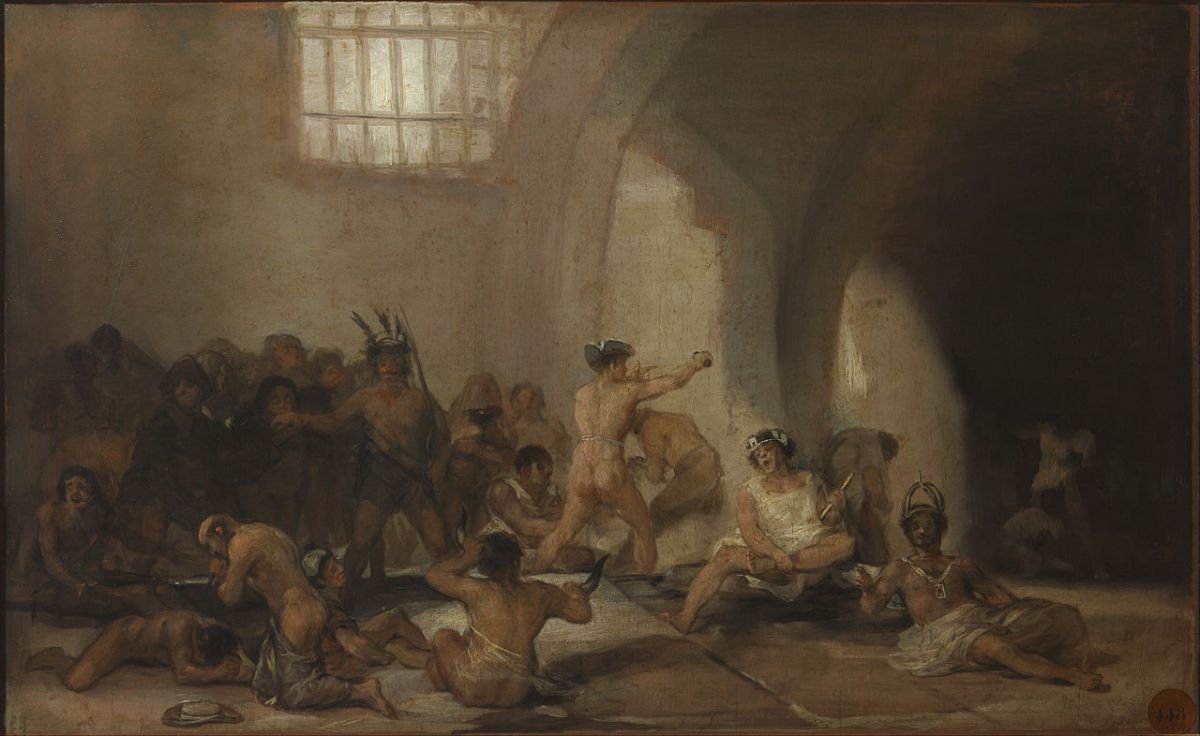
The Madhouse (Spanish: Casa de locos) or Asylum (Spanish: Manicomio) Francisco Goya- 1812-1819

The following are some exercises which I have found useful in moving into Equanimity.

1-      Write down ways in which one starts becoming less balanced. 

A written record of the ways in which one starts going into the cycle of expectations, desires, wants, fears, greed, disgust can give a good opening into the habits of the heart and head. One way to sharpen this focus is to read a newspaper/news-site for 15 minutes and keep classifying under the headings of greed, fear, disgust the feelings evoked by the articles.

 2- Developing Borders and Boundaries:  Remembering Spencer (White, 1984; White, 2007)

Spencer, the young boy who had the issue of soiling was told to characterize in near and particular terms, how this issue is affecting and ruling his life. His parents were told to characterize how this issue rules and ruins their lives. Then Spencer was asked to give a name to this issue of Soiling. He called it Mr.Mischief. They went on to relate to this issue in a particular rather than general manner, and in a near rather than distant way, thus helping define the boundaries and borders of the issue, get a better handle on it and define their relationship to the issue. 

This example of Spencer, illustrates how to externalize and objectify an issue which is affecting one’s life, and then create a statement of position map, which can help one create a plan and monitor our process.

3-     Creating personal examples : Balance of the Lotus

Eastern traditions see the Lotus flower as an embodiment of purity, enlightenment and rebirth. The balance between beauty and adversity are shown in the growth process of the Lotus, as it emerges above mud and water. It symbolizes  harmonious balance between earthly struggles and divine purity.

Nature walks and creating living symbols of these experiences has been a way to enhance balance in my life.

4- Case Scenario: Anger seen through different counselling approaches (Narrative/CBT)

Mr. S, presents with anger, which has affected his work, relationships, standing in community

NARRATIVE THERAPY APPROACH

  • Externalize – The history of anger, as if it is a creature outside of oneself waiting to get inside you
  • Therapist Role-is on listening, accepting, non-judgmental, non-confrontational statements..to be like a Junior Partner, Investigative Journalist, 

CONTRAST WITH CBT APPROACH

BASIC ID-Behaviour- writes angry letters, throws plants 

Affect                feels humiliated 

Sensations        pounding heart

Imagery              sees himself being taken away from grandson

Cognitions          I am a middle aged man who is being deprived of my rights,

                             standing in unfair manner

Interpersonal     angry at wife , sons, in-laws

Drugs                 takes alcohol to drown the pain

NARRATIVE THERAPY approach uses interventions like externalizing, metaphors, mapping to develop a near and particular relation with the issue.

Mr.S went into the history of anger, by asking to see it as a creature outside oneself who is thinking of ways to trick him into losing his calm.  Mr.S told of his early years of immigration from Bombay, India to Canada, how he saw his mother being beaten by his alcoholic father, his being bullied in school. As he became a teenager, he stopped these things as best as he knew.The “Bullied became the Bully”. On being asked to give a name for Mr.Anger he came up with two metaphors. He first called Mr.Anger the “Dragon”. However, on reflection he said, “If I am still riding this creature and getting taken for a ride in my seventh decade of life, then I am riding a Mr.Donkey”.

 After establishing rapport, agreeing that anger-related issues are worth exploring and addressing, we set about seeing how Mr.S has constructed his life around anger by

1- Externalizing anger

2- Deconstructing anger narratives

3- Re-authoring personal stories

4- Exploring values and intentions

5-Creating alternative responses

1- Externalizing anger

       Encouraging Mr.S to treat Mr.Anger as a separate entity or character helped distance himself from anger and view it as something outside of his core identity. Be doing this he gained a new perspective on his anger, started seeing how his life would be without anger and create a map to challenge the dominance of anger in his life.

2- Deconstructing anger

         We explored the stories and meanings Mr.S attaches to his anger. Through telling these stories we were able to examine the underlying beliefs, assumptions, and cultural influences that contribute to his anger. For example, as he recalled the weekend discussions which turned into angry arguments in his family of origin, he became more clear about how issues of safety, and the way to deal with un-ease through lashing out or suppressing became a dynamic in his life. This has in different forms played out in his family of creation, and he can now see this pattern even in his interactions with the in-laws of his sons. Deconstruction helped gain insight into the origins and maintenance of anger.

Scripting of the scenarios which continue to trouble him in is life in the present, helped develop alternative interpretations. Through role plays, we started developing better results.We refined these approaches through counselling and keeping an Anger Journal (He called it Riding with Mr.Donkey journal)

3- Reauthoring personal stories: 

The scripts made through externalization,deconstruction tools above helped Mr.S gain the power to rewrite his narratives, explore alternative perspectives and be more aware of how his prejudices and projections are affecting his relationships. New stories began to emerge which offered new ways of understanding and creating his experiences.

Shifting from being defined by anger to seeing himself as capable of change and growth, and being a channel of peace, understanding, and kindness has helped Mr S and his family be very different from where they were a year ago.

4- Exploring values and intentions: 

As Mr.S evolved from a “Head over Water” Survival level recovery to a more wholesome bigger version of himself, he began to examine his values and vulnerabilities, intentions and impact regarding anger. As we explored pivotal life moments, the purpose anger has served in his life, he changed his way of looking at his teenage years, and also his work, family and community. This led to a deeper understanding of his emotional experiences.

 This exploration  paved the way for aligning anger with personal values, he rebuilt his relationship with his estranged wife and children, and has started exploring healthier ways of expressing his needs, feelings, situations and story.

5- Creating alternative responses: 

The list of alternative responses to Mr.Anger (Dragon/Donkey) helped challenge the dominant narrative that aggressive or destructive behaviours result from anger. He started developing new strategies to harness anger constructively. His strengths, resources, alternative stories enabled him to respond to anger in ways more in life with desired outcomes.

Key points and summary

Creating balance through understanding the borders and boundaries of an issue helps one come up with creative ways to enhance life. Through keeping a written record of the way issues like anger speak in one’s life, how they disturb equanimity, we saw two different approaches to this issue- a classic Cognitive Behavioural therapy (CBT) approach and a Narrative therapy approach (NT). Creating a positive journal of values, symbols and metaphors (Lotus, dragon, donkey, map, territory, journey) helped co-create better life options. 

Exercise

       Do you have an issue which you need to see through a different lens? Write how it has spoken to you in your life and discuss as appropriate. Alternatively, write a letter to the issue.

White, M. (1984). Pseudo-encopresis: From avalanche to victory, from vicious to virtuous cycles. Family Systems Medicine, 2(2), 150–160. https://doi.org/10.1037/h0091651

White, M. (2007). Maps of narrative practice. WW Norton & Company.

Modern man no longer communicates with the madman . . 

. There is no common language, or rather, it no longer

 exists……..The language of psychiatry, which is a monologue 

by reason about madness, could only have

 come into existence in such a silence.

Foucalt, 1961